Trust you all received the message this afternoon regards the earthquakes...hope you are all safe and well and have a better sleep tonight!
Weekly update...
I am not sure how everyone else spent their very wet Saturday but I took time to read through Rotary Downunder magazines, including some back copies. I have to admit it is not a publication that I read from cover to cover … a little too much of a focus on Australia. However I did find an interesting piece written by a contributor lamenting the apparent shift by Rotary International away from its roots as group of autonomous Service Clubs to a more centralised corporate image conscious organisation.
In the same edition their was an article on youth suicide and how prevalent it was on both sides of the ditch. Both articles did get me thinking about the importance of what we can do tackle difficult issues and the central role that it plays in defining our purpose as Rotarians. Through Rotary programmes we support young leaders, which is very important, however should we also be looking to do something for those who are struggling with bullying, mental issues and despair, where there appears to be no future and the only way out is to end it all. If anybody is interested in this important issue please contact me.
Just how many fish species are there in New Zealand waters? And are we there yet in identifying them all?
The answers are we don’t know and definitely not, according to Te Papa collections manager Andrew Stewart. Andrew is an editor of the massive door-stopper Fishes of New Zealand – four volumes covering 1262 species over 2008 pages – published last year.
Already it is out of date.
Forty more species have been found since publication and a new one is being added on average every five weeks.
That total stands to increase even more when Andrew heads to the Kermadecs next month aboard the research vessel Tangaroa for a three-week exploration down to 3000 metres on the slopes of the Kermadec Trench.
In an entertaining address Andrew introduced some extraordinary marine denizens such as the lollypop wrasse, the robust assfish and a blobfish with an uncanny likeness to Donald Trump.
A particular favourite was a deepsea angler fish known as the cosmopolitan dreamer. The male of the species attached to the female like a parasite and was eventually absorbed, becoming little more than “a set of balls”.
Some previously unknown fish are right on our doorstep, such as a clingfish found in Wellington Harbour “hiding in plain sight”. Andrew expects the number of known species will almost double to 2000 by mid-century.
“We really don’t know what’s out there,” he said.
“We have really only learnt what we don’t know. Most of the EEZ is largely unexplored.” Over half of New Zealand’s huge zone, the fourth or fifth largest in the world, is deeper than 2000m. That is beyond commercial fishing depth.
Andrew said he loved it when he got a call from a skipper saying he had found a strange new fish and would he like him to bring it ashore.
“Hell yes,” was the invariable response.
Would you like to mentor a young person in Rotaract?
Then this is for you!
Chelsea from Rotaract put herself forward and was successful being appointed as club Treasurer this year. Chelsea is keen to have a mentor to help her as she learns and fulfils this role.
If you would like to do this please contact Lisa King - email lisakingaling@gmail.com or phone 2325685.
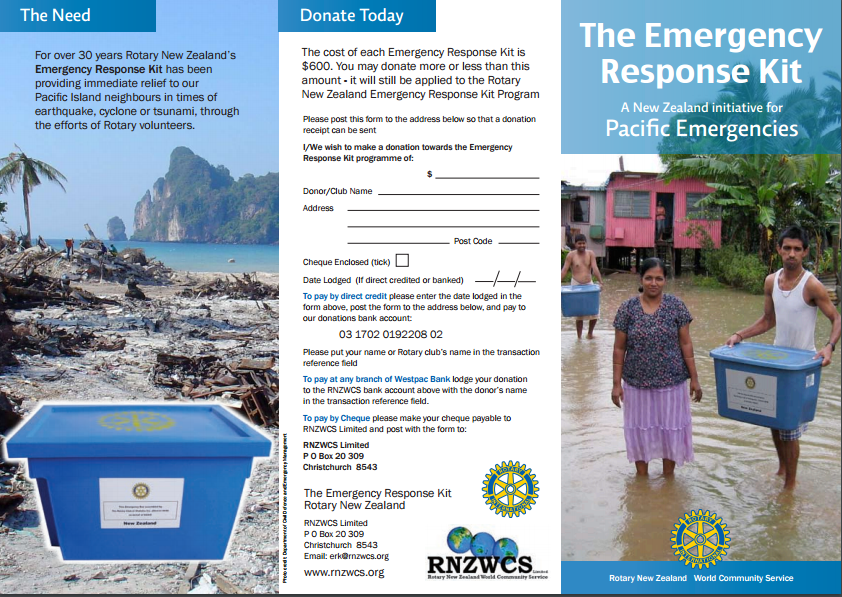
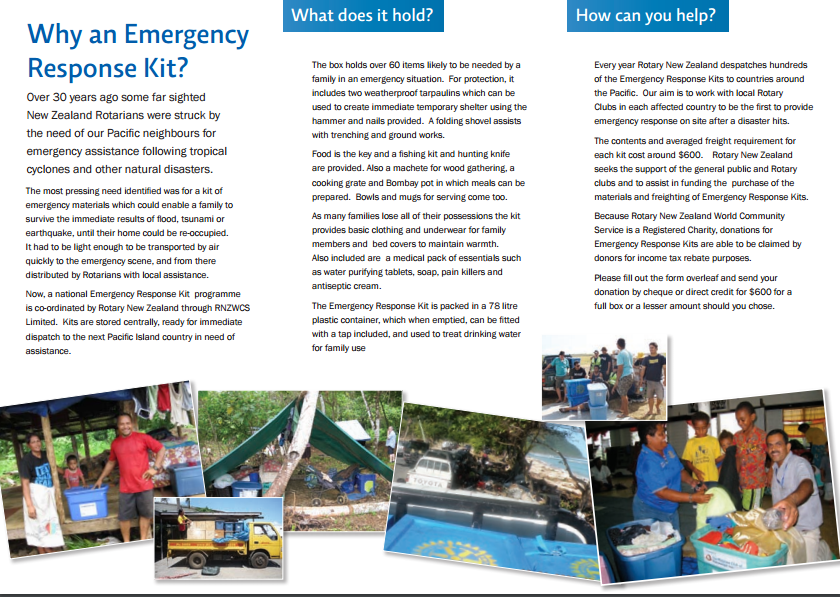
We are currently purchasing and packing 1,000 Emergency Response Kits (ERKs) to replace the 1,000 distributed in Fiji following Cyclone Winston. This came hard on the heels of the 1,000 distributed following Cyclone Pam in Vanuatu and equates to four Kits per New Zealand Rotary Club for both distributions.
Your support of this Rotary New Zealand initiative is much appreciated.


.jpg)


.jpg)