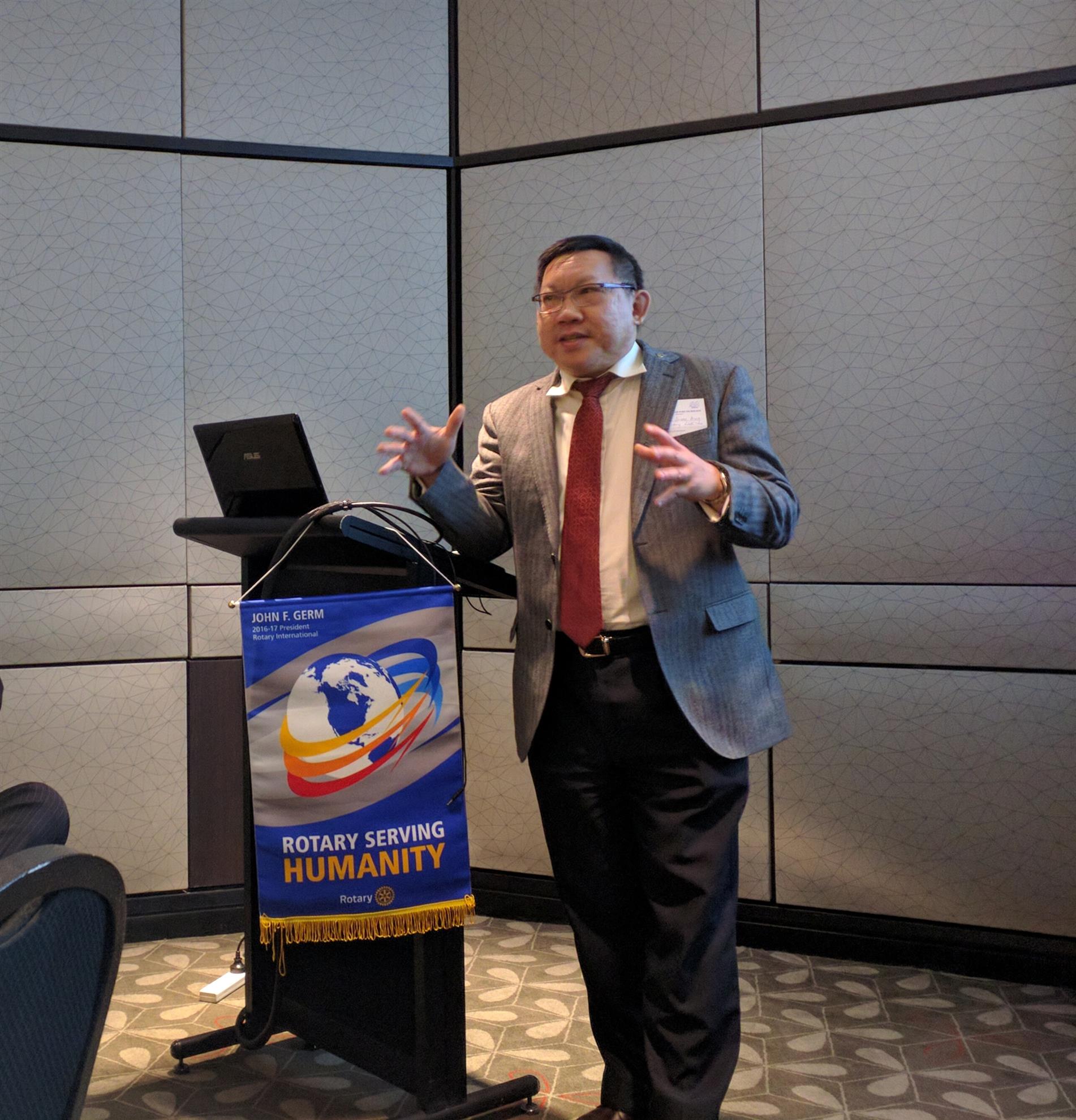
Professor Siah Hwee Ang is the inaugural Chair in Business in Asia at Victoria University. This is a new position sponsored by the Bank of New Zealand. Professor Ang's main research interests are in the fields of corporate strategy, international business strategy and technology strategy. He has worked/is currently working with executives from Fletcher Building, Fairfax Media, TVNZ, and Fonterra. He commented that he has 5 “bosses” to keep happy, including producing weekly and monthly columns for Fairfax media.
Professor Ang gave a very entertaining and informative talk on the recent economic development in China, Asia and International business. He noted that China, as the second largest economy in the world, has been growing at about 6% per year (compared to global growth of 3%) but this is expected to slow in the near future. However with this growth comes some challenges: the uneven growth between the east of China (high growth) and west of the country (low growth) and over capacity, which leads to trade imbalances such as cheap Chinese steel flooding the NZ market. It also makes property highly unaffordable, driving investors to look offshore.
As part of his talk Prof Ang highlighted two specific issues – China’s membership of the World Trade Organisation and the “One belt, one road” initiative. When China joined the WTO 15 years ago it did so under a strict tariff regime to be reviewed after 15 years. China holds the view that tariffs should/would be removed after this period, while Europe holds the view that they should be ‘reviewed’. This may have ramifications globally, as protectionism issues more broadly need to be dealt with.
One belt one road (OBOR) are Chinese trade route initiatives that can be seen, variously, as mechanisms to drive global development, infrastructure challenges or a means to manage China’s excess capacity. The one “road” is a sea trade route from eastern china to the rest of Asia and northern Africa and the one “belt” is a rail route across China to Europe (there is now a freight train from Yiwu to Madrid, taking 21 days). Existence of OBOR raises a range of issues including security challenges and local vs global benefits.
Prof Ang’s talk sparked a number of questions from the floor which looked at the degree of protectionism in China, both economic and political, the veracity of China’s government statistics (ask me about that some quiet morning) and the willingness of the Chinese government to deal with corruption - only the very biggest scandals are dealt with.
Teresa
|